Most Dangerous Area in the World by Stephen G. Rabe
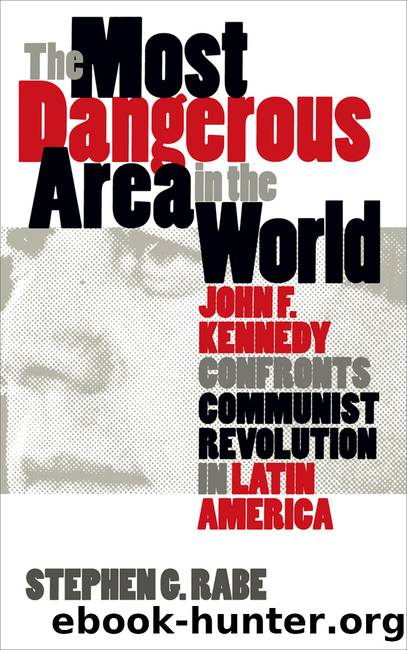
Author:Stephen G. Rabe [Rabe, Stephen G.]
Language: eng
Format: epub
Tags: International Relations, History, Political Science, General
ISBN: 9781469617367
Google: hVhuAwAAQBAJ
Goodreads: 26522460
Publisher: UNC Press Books
Published: 1999-02-01T00:00:00+00:00
7 Alliance for Progress
The Kennedy administration devoted a remarkable amount of time and effort to inter-American relations. It intervened in the Dominican Republic and Haiti, attempting to create decent, democratic regimes. It confronted what it considered dangerous radicals in countries such as Brazil, British Guiana, Chile, and Guatemala. It changed regional military assistance programs from hemispheric defense to internal security. And it tried to overthrow the regime of Fidel Castro. Administration officials judged those efforts as emergency measures, aimed at countering the international Communist movement and protecting U.S. national security. Officials constantly professed that the United States would enjoy lasting security only when Latin Americans lived in prosperous, socially progressive, free societies. Once the economic growth and development engendered by the Alliance for Progress took hold, Latin America would no longer be âthe most dangerous area in the world.â The transformation of Latin America would justify U.S. global leadership and demonstrate the nationâs ability to accomplish enlightened, anti-Communist policies. But the Kennedy administration found the challenge of nation building in Latin America far more daunting than it had envisioned. The Alliance for Progress proved a notable policy failure of the 1960s, superseded only by the U.S. debacle in Vietnam.
The Alliance for Progress did not achieve the ninety-four enumerated goals set forth in the charter adopted at Punta del Este in August 1961. The fundamental goal was to achieve a real economic growth rate of ânot less than 2.5 percent per capita per year.â (Because Alliance planners expected Latin Americaâs population to grow by 3 percent a year, they actually expected at least a 5.5 percent annual growth rate.) Economic growth was vital, for it would underwrite improvements in health, education, and welfare. Alliance planners considered the 2.5 percent goal a modest, readily attainable objective; most quietly expected an even better economic performance. Although analysts have offered slightly different data, all have concluded that Latin American economies performed poorly during the 1960s. Between 1961 and 1967, growth rates averaged less than 2 percent a year. Economic growth rates did not exceed those of the unprosperous 1950s. At less than 1 percent a year, economic growth during the Kennedy years was especially disappointing. Only smaller Central American nations, like Panama and Nicaragua, surpassed the 2.5 percent goal. Of the larger nations, Mexico enjoyed the best economic growth, but its economy had been expanding since 1940, and Mexico was not a major recipient of U.S. economic assistance.1 Some analysts have subsequently suggested that the Alliance laid the foundation for future success. At the end of the decade, Brazil, under its military rulers, began to grow rapidly, and much of Latin America achieved some growth between 1968 and 1973. The rapid increase in petroleum prices that followed the Arab-Israeli War of 1973 and the ensuing Arab oil embargo halted that growth.2 But at the time, administration officials found it hard to talk of progress. During his 1968 presidential campaign, Robert Kennedy emphasized the absence of growth and change in Latin America.3 With slow economic
Download
This site does not store any files on its server. We only index and link to content provided by other sites. Please contact the content providers to delete copyright contents if any and email us, we'll remove relevant links or contents immediately.
| Arms Control | Diplomacy |
| Security | Trades & Tariffs |
| Treaties | African |
| Asian | Australian & Oceanian |
| Canadian | Caribbean & Latin American |
| European | Middle Eastern |
| Russian & Former Soviet Union |
The Secret History by Donna Tartt(19088)
The Social Justice Warrior Handbook by Lisa De Pasquale(12190)
Thirteen Reasons Why by Jay Asher(8909)
This Is How You Lose Her by Junot Diaz(6886)
Weapons of Math Destruction by Cathy O'Neil(6279)
Zero to One by Peter Thiel(5801)
Beartown by Fredrik Backman(5754)
The Myth of the Strong Leader by Archie Brown(5507)
The Fire Next Time by James Baldwin(5444)
How Democracies Die by Steven Levitsky & Daniel Ziblatt(5218)
Promise Me, Dad by Joe Biden(5153)
Stone's Rules by Roger Stone(5087)
A Higher Loyalty: Truth, Lies, and Leadership by James Comey(4962)
100 Deadly Skills by Clint Emerson(4925)
Rise and Kill First by Ronen Bergman(4788)
Secrecy World by Jake Bernstein(4753)
The David Icke Guide to the Global Conspiracy (and how to end it) by David Icke(4717)
The Farm by Tom Rob Smith(4507)
The Doomsday Machine by Daniel Ellsberg(4490)
